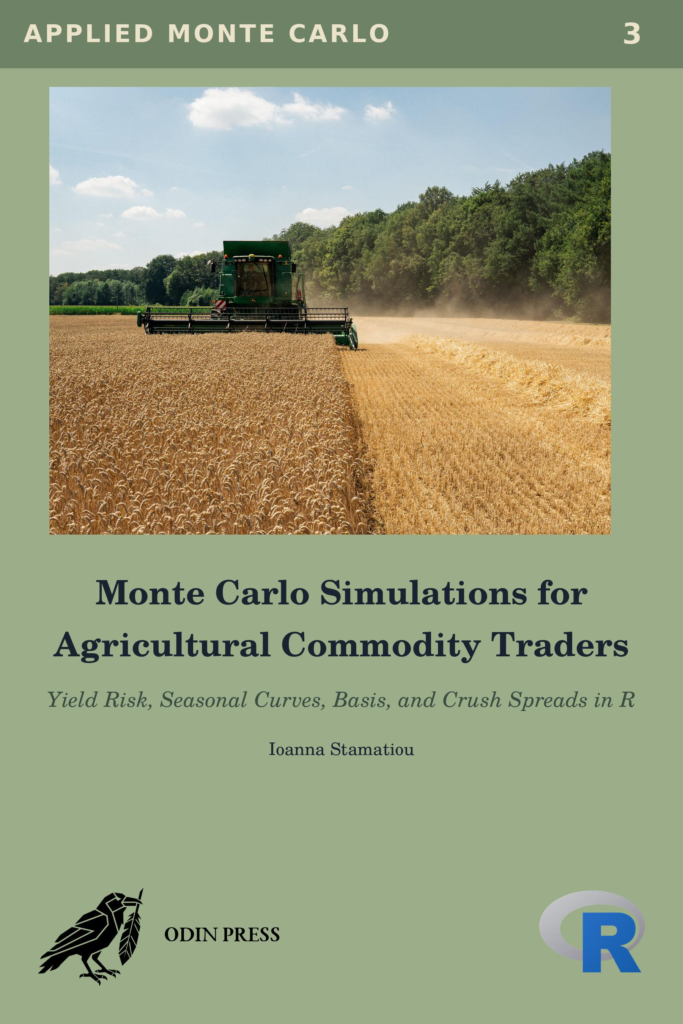
Monte Carlo Simulations for Agricultural Commodity Traders
Yield Risk, Seasonal Curves, Basis, and Crush Spreads in R
| Publication year | 2026 |
|---|---|
| Number of pages | 318 |
| Paper trim | 6 × 9 inch |
| Paper color | White |
| ISBN — Paperback | Forthcoming |
| ISBN — Hardcover | N/A |
| ISBN — Dust Jacket | N/A |
About this book
Agricultural commodity traders run the oldest risk business in the world on some of the newest borrowed mathematics. The quantitative desks price corn with machinery built for equities and crude — flat-volatility diffusions, constant correlations, a single fair value quoted for new-crop six months before pollination — and the machinery is wrong in ways that are structured, seasonal, and expensive. A grain price has a calendar in its mean and a calendar in its volatility; it mean-reverts on the clock of the stocks-to-use cycle, not the trading day; it jumps when a heat ridge parks over the corn belt in July; and it cycles on its own supply response, because the acreage that answers this year’s price is harvested into next year’s market. None of that is exotic. All of it is absent from the standard toolkit, and every omission lands in the tail of somebody’s book.
The literature has not closed the gap. Glasserman’s Monte Carlo Methods in Financial Engineering is the method canon, calibrated to derivatives desks; Owen is comprehensive and audience-agnostic; the agricultural-economics literature understands cobwebs and storage but does not ship a simulation engine a desk can run. Schwartz–Smith and Sørensen supplied the factor models two decades ago, yet the trader who wants a working, calibrated, honest price simulator for corn still has to assemble it from a dozen papers and trust parameters nobody re-estimated on current data. This book is that assembly, done once, in the open, against data anyone can pull for free.
The book builds one engine in seven layers, every layer calibrated to real FRED and NOAA series with the estimating R code printed where it runs: a Fourier seasonal mean; a mean-reverting deviation with compound-Poisson weather jumps; a Schwartz–Smith two-factor equilibrium estimated by the Kalman filter; a seasonal stochastic-volatility envelope — thirteen percent annualized in February, thirty in July — multiplied by a GARCH core; a Markov regime-switching layer with ENSO carried honestly as a weak, crop-specific drift covariate rather than the strong driver the data refuses to support; a competitive-storage cobweb that generates the multi-year cycles and asymmetric spikes from economics rather than statistics; and a demand layer whose elasticity, feed substitution, and ethanol-era energy coupling cut the supply-only one-percent tail from a fictitious ninety-one percent to the seventeen the market actually shows. The assembled engine then earns its keep: a storage option valued by least-squares Monte Carlo, the soybean board crush priced as the spread it is, a seasonal value-at-risk and expected shortfall computed month by month, and a backtest that reports its own failure — the Christoffersen independence rejection — as a finding instead of burying it. The last chapter recalibrates everything across four crops and reads off the parameter fingerprints that separate a storable temperate grain from a concentrated tropical perennial.
Contents
- The Weather Lottery: Why Monte Carlo Is Mandatory in Agricultural Markets
- Data and Stylized Facts: Building the Calibration Anchor from FRED
- The Crop Calendar: Deterministic Seasonality in the Price Mean (Layer 1)
- Short-Term Deviations and Weather Shocks: Mean Reversion with Jumps (Layer 2)
- The Long View: Two-Factor Equilibrium and the Secular Trend (Layer 3)
- The Weather Market: Seasonal Stochastic Volatility (Layer 4)
- El Nino and Regime Switching: Climate States in the Price Process (Layer 5)
- The Cobweb: Endogenous Multi-Year Cycles from Supply Response (Layer 6)
- The Demand Side: Elasticity, Substitution, and the Ethanol Link (Layer 7)
- Pricing and Risk: Storage Options, Crush Spreads, and Seasonal VaR
- One Model, Many Crops: A Comparative Atlas from Corn to Cocoa
Covers