The Resolvent Method for PDEs
Solving Evolutionary Equations Where the Semigroup Cannot
by T. Zamrik
Contents
- Preface
- 1The Resolvent and the Semigroup: A Laplace Duality
- 2Sectorial Operators and Holomorphic Semigroups
- 3The Dunford–Riesz Functional Calculus
- 4Resolvent Estimates and Maximal Regularity
- 5Non-Self-Adjoint Generators and the Failure of Eigenexpansion
- 6Pseudospectra: When Eigenvalues Mislead
- 7Degenerate and Non-Densely-Defined Generators
- 8Evolution Families and the Nonautonomous Cauchy Problem
- 9Constructing the Propagator from Frozen Resolvents
- 10Volterra and Fractional-in-Time Equations: Resolvent Families
- 11Accretive Operators and the Nonlinear Resolvent
- 12Viscosity Solutions and the Hamilton-Jacobi-Bellman Equation
- 13Policy Iteration as Iterated Linear Resolvents
- 14Time-Inhomogeneous HJB via the Nonautonomous Nonlinear Resolvent
- A Source Code
- Bibliography
- Index
- About the Author
About this book
The standard theory of evolution equations puts the semigroup — the exponential of the generator — at its centre and treats the resolvent, the inverse of the shifted generator, as scaffolding. This book reverses the order. The resolvent is the Laplace transform of the semigroup: prior to it, and, unlike it, available even where no semigroup exists.
That is not a matter of taste. There is a ladder of problems on which the semigroup degrades or vanishes while the resolvent still carries the solution: • the spectrum betrays you — non-self-adjoint generators, where pseudospectra tell the truth the eigenvalues cannot; • time refuses to factor — non-autonomous and fractional-in-time problems, where the propagator is built from frozen resolvents; • nonlinearity — where the nonlinear resolvent solves the Hamilton–Jacobi–Bellman equation.
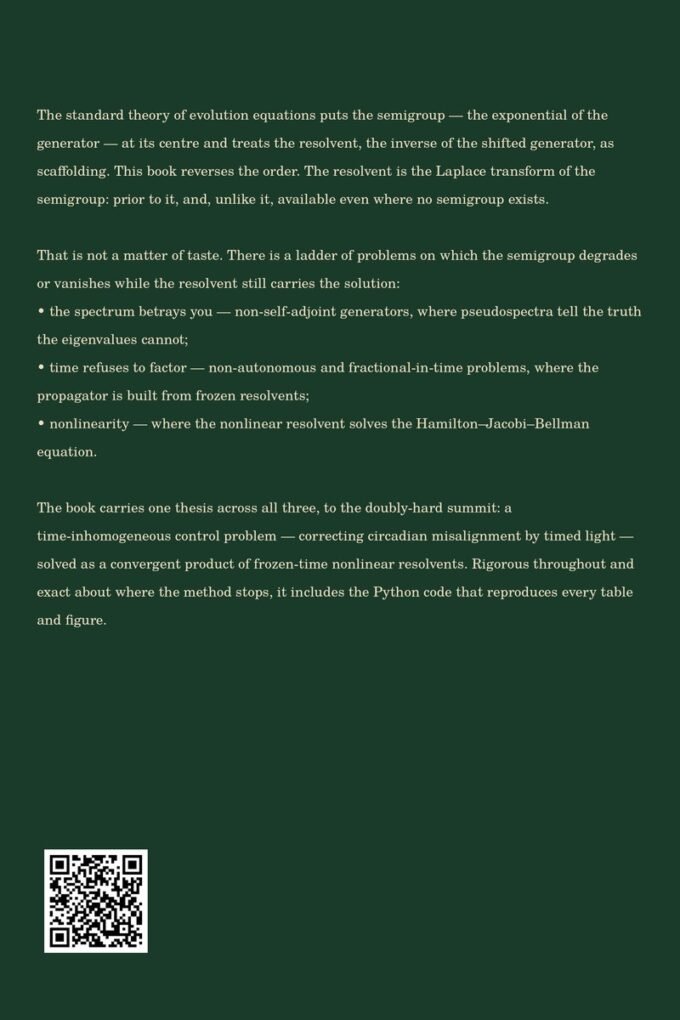
The book carries one thesis across all three, to the doubly-hard summit: a time-inhomogeneous control problem — correcting circadian misalignment by timed light — solved as a convergent product of frozen-time nonlinear resolvents. Rigorous throughout and exact about where the method stops, it includes the Python code that reproduces every table and figure.
The covers