
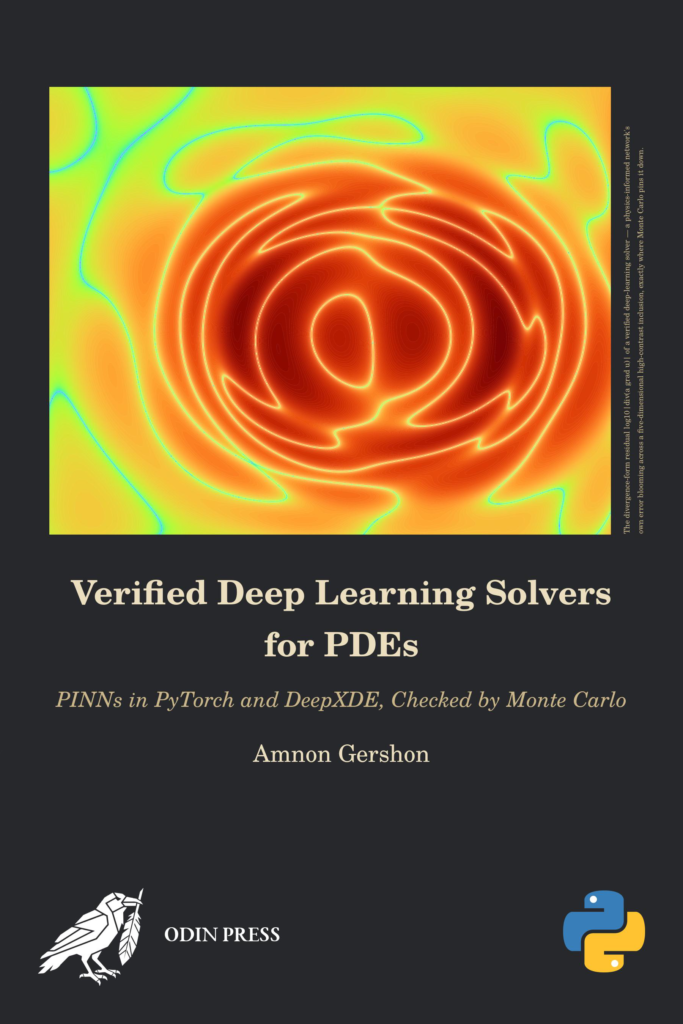
Verified Deep Learning Solvers for PDEs
PINNs in PyTorch and DeepXDE, Checked by Monte Carlo
| Publication year | 2026 |
|---|---|
| Number of pages | 512 |
| Paper trim | 6 × 9 inch |
| Paper color | White |
| ISBN — Paperback | Forthcoming |
| ISBN — Hardcover | N/A |
| ISBN — Dust Jacket | N/A |
About this book
A partial differential equation in three variables is solved on a grid. A partial differential equation in fifty variables is not — there is no grid, because the number of points one would need exceeds the number of atoms one has. This is the curse of dimensionality stated without ornament, and for most of my working life it marked the boundary of what deterministic numerical analysis could do. Inside the boundary we had finite differences and finite elements, and they were excellent. Outside it we had almost nothing, and we knew it.
Neural networks crossed that boundary. A physics-informed network represents the solution of a PDE not on a mesh but as a function, parameterized by weights and trained to make the equation’s residual small at scattered collocation points. Because the representation is mesh-free, the dimension that defeats a grid no longer defeats the solver in the same way. Networks now produce solutions to high-dimensional semilinear equations, to committor problems, to Schrödinger ground states, that no grid I ever built could have reached. The advance is real. I do not dispute it, and this book makes daily use of it.
But a trained network comes with no error certificate. This is the gap the book exists to close. A finite-element solution carries a posteriori error estimates; a physics-informed network carries a training loss, and a training loss is not an error. I have watched a network drive its residual to near-zero on its collocation points while its solution was visibly wrong between them — in a domain those points could never have covered. A wrong solution and a right one look identical until something independent is brought to bear. Early in my career a finite-difference scheme converged cleanly, smoothly, confidently, to the wrong answer, and nothing in the residual warned me; a crude Monte Carlo estimate did. I have not trusted a single solver’s word for anything since.
Contents
- The Bridge: PDEs with a Monte Carlo Twin
- Steady Heat: Poisson on a Reentrant Corner, Checked by Walk-on-Spheres
- Electrostatics in Awkward Geometry: Laplace, Corners, and Mesh-Free Solving
- Diffusion with Absorption: Parabolic Problems and Killed Brownian Motion
- Escape from a Potential Well: Mean First-Passage Time and Exit Simulation
- Committor Functions: Transition Paths and Rare-Event Monte Carlo
- Heterogeneous Media: Variable-Coefficient Diffusion and Its Stochastic Twin
- Reaction-Diffusion Fronts: Fisher-KPP and Branching Brownian Motion
- The Schru00f6dinger Ground State: Eigenvalue Problems and Diffusion Monte Carlo
- High-Dimensional Semilinear PDEs: The Deep BSDE Method
- Control Variates: When the Network Accelerates the Monte Carlo
- Pricing a Basket Option: High-Dimensional Black-Scholes and Option Monte Carlo
- Equilibrium Densities: The Stationary Fokker-Planck Equation and Long-Run Langevin Sampling
- Where It Breaks: Advection, Shocks, and the Honest Boundary
Covers
Extra Material by the Author
- Companion code — GitHub → link
- Errata & updates → link