
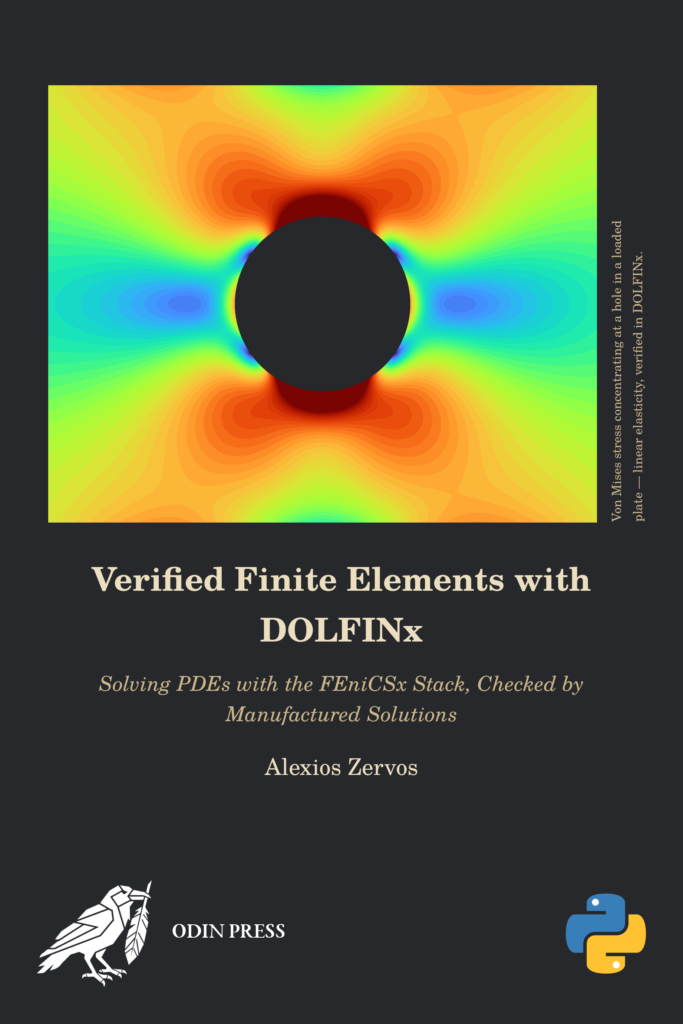
Verified Finite Elements with DOLFINx
Solving PDEs with the FEniCSx Stack, Checked by Manufactured Solutions
| Publication year | 2026 |
|---|---|
| Number of pages | 518 |
| Paper trim | 6 × 9 inch |
| Paper color | White |
| ISBN — Paperback | Forthcoming |
| ISBN — Hardcover | N/A |
| ISBN — Dust Jacket | N/A |
About this book
A finite-element simulation you cannot verify is an opinion, not a result. I have believed this for forty years, and nothing in the migration of the finite-element community onto DOLFINx has given me cause to soften it. A new solver, a cleaner library, an assembly kernel far faster than the one before — these are welcome, and this book is built on them. But a new tool is exactly when a discipline’s verification habits lapse: the tool is exciting and the checking is not, and a smooth-looking stress field asks no questions of the person who produced it. This book exists so the move to DOLFINx does not cost us the one habit that separates a computed result from a guess: forcing a solver to reproduce an answer we already know before we trust one we do not.
The gap this book fills is not in the methods: the finite-element method is old, its theory settled, DOLFINx implements it well. The gap is that the methods are almost always taught as if producing a field were the end of the work, when it is only the beginning. A textbook shows the weak form, assembles the matrix, and plots the solution; it rarely measures whether that solution converges at the order the theory promised, and almost never for every method it presents. The commercial packages are worse, not because their elements are wrong but because you cannot audit them — I have watched two disagree by fifteen percent on the same thermal-stress problem, neither willing to show me its quadrature. An unauditable result is untrustworthy, however professional the picture. What has been missing is a book that solves real problems with a modern open stack and verifies every one of them, in the open, by a method the reader can run himself.
So that is what this book does, the same way throughout: every method is verified before it is trusted. Where a problem has a closed-form solution — a Lamé cylinder, a Timoshenko bimetallic strip — the computed answer is matched against it. Where it does not, and most real geometries do not, the code is verified by the method of manufactured solutions: cook a solution, derive the forcing it satisfies, and measure whether the error falls at the a-priori rate the theory promises. The convergence table goes on the page: I do not report “good agreement,” I report the slope and let it make the argument. Where neither a closed form nor a manufactured solution settles the matter, the physics does — a reaction-force balance that must sum to zero, a peak stress that must stop moving as the mesh refines, the same answer on one processor and on eight. The book is candid, too, about where the method quietly fails: the volumetric locking that stiffens a low-order element to nonsense without warning, the checkerboard pressure of an inf-sup pair chosen by habit, the geometry error that hides in a functional rather than a solution slope. Every figure is produced by one self-contained file against a pinned library version; a figure you cannot regenerate is an anecdote, and there are none here.
Contents
- The Weak Form and Your First Solve: Poisson from Space to Solution
- Verification as a Discipline: Manufactured Solutions and the Order p+1
- Boundary Conditions, Done Right: Dirichlet, Neumann, and Robin, Each Verified
- Meshes and Geometry: From Built-In Grids to gmsh Import and h-Refinement
- Function Spaces and Elements: Lagrange, Higher Order, and the Basix Zoo
- Vector Problems: Linear Elasticity, the Patch Test, and Volumetric Locking
- Time-Dependent Problems: The Heat Equation in Space and Time
- Mixed and Saddle-Point Problems: Stokes, the inf-sup Condition, and Tayloru2013Hood
- Nonlinear Problems: Newton's Method and the Automatic Jacobian
- Solvers and Preconditioning with PETSc: From Direct Factorization to Field-Split
- Parallelism and Performance: MPI by Default and Rank-Independence as a Check
- Reproducible Workflows: I/O, Checkpointing, and the Verification Dashboard
- The Steel Wrench: Geometry, Mesh, and the One-Way Thermo-Mechanical Solver
- The Real Part, Verified: MMS on the Wrench and Temperature-Dependent Steel
- At Scale and the Full Report: Transient Heating, Combined Load, and the Dashboard
Covers
Extra Material by the Author
- Companion code — GitHub → link