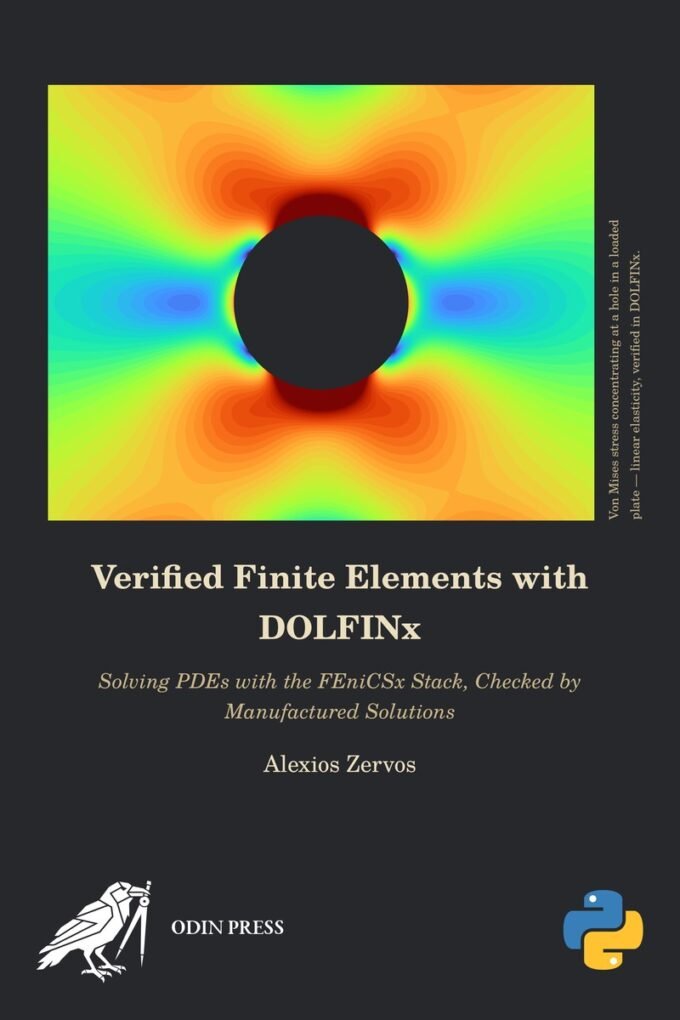
Verified Finite Elements with DOLFINx
Solving PDEs with the FEniCSx Stack, Checked by Manufactured Solutions
Contents
- Preface
- List of Figures
- List of Tables
- 1The Weak Form and Your First Solve: Poisson from Space to Solution
- 2Verification as a Discipline: Manufactured Solutions and the Order p+1
- 3Boundary Conditions, Done Right: Dirichlet, Neumann, and Robin, Each Verified
- 4Meshes and Geometry: From Built-In Grids to gmsh Import and h-Refinement
- 5Function Spaces and Elements: Lagrange, Higher Order, and the Basix Zoo
- 6Vector Problems: Linear Elasticity, the Patch Test, and Volumetric Locking
- 7Time-Dependent Problems: The Heat Equation in Space and Time
- 8Mixed and Saddle-Point Problems: Stokes, the inf-sup Condition, and Taylor–Hood
- 9Nonlinear Problems: Newton’s Method and the Automatic Jacobian
- 10Solvers and Preconditioning with PETSc: From Direct Factorization to Field-Split
- 11Parallelism and Performance: MPI by Default and Rank-Independence as a Check
- 12Reproducible Workflows: I/O, Checkpointing, and the Verification Dashboard
- 13The Steel Wrench: Geometry, Mesh, and the One-Way Thermo-Mechanical Solver
- 14The Real Part, Verified: MMS on the Wrench and Temperature-Dependent Steel
- 15At Scale and the Full Report: Transient Heating, Combined Load, and the Dashboard
- A Source Code
- References
- Index
- About the Author
About this book
A finite-element simulation you cannot verify is an opinion, not a result. This book solves real PDEs with DOLFINx and the FEniCSx stack and verifies every method it presents — in the open, by a test the reader can run — because verification comes before validation, and a slope you can measure beats a picture you can only admire.
The code is the argument, and all of it is here. Every figure comes from one self-contained Python program — the weak form in UFL, the mesh in gmsh, the system through PETSc, run in parallel over MPI — each printed in the book, runnable against a pinned stack. Newton converges quadratically on an automatic Jacobian; a Stokes flow stays stable on an inf-sup pair; a steel wrench is solved from CAD as a coupled thermo-mechanical system. Nothing is a black box, nothing left as an exercise.
Where a problem has a closed form, the answer is matched against it; where it does not, manufactured solutions measure the error against the order the theory promises. The book is candid about where finite elements quietly fail — volumetric locking, checkerboard pressure, geometry error hiding in a functional — and names the test that catches each. It builds to one verified analysis: a steel wrench, heated until its steel softens and loaded until it yields, reported down to the safety factor below one.
The covers
