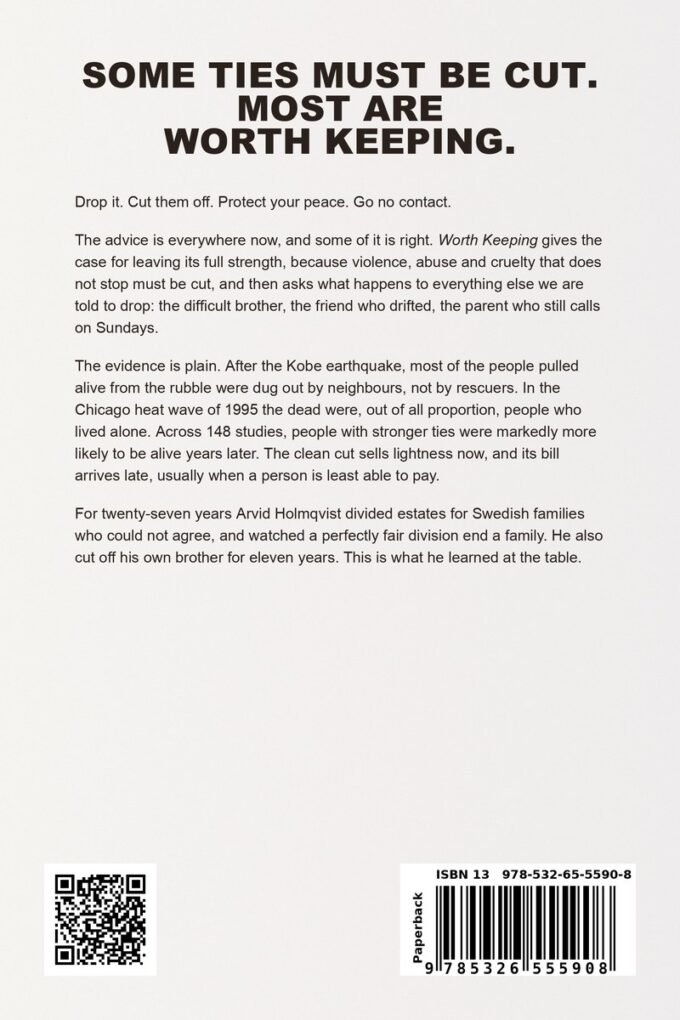
Some ties must be cut. Most are worth keeping.
Worth Keeping
Why the ties you’re told to drop are the ones holding you up
And if one prevail against him, two shall withstand him; and a threefold cord is not quickly broken.— Ecclesiastes 4:12, The Holy Bible, King James Version (1611)
About this book
Drop it. Cut them off. Protect your peace. Go no contact.
The advice is everywhere now, and some of it is right. Worth Keeping gives the case for leaving its full strength, because violence, abuse and cruelty that does not stop must be cut, and then asks what happens to everything else we are told to drop: the difficult brother, the friend who drifted, the parent who still calls on Sundays.
The evidence is plain. After the Kobe earthquake, most of the people pulled alive from the rubble were dug out by neighbours, not by rescuers. In the Chicago heat wave of 1995 the dead were, out of all proportion, people who lived alone. Across 148 studies, people with stronger ties were markedly more likely to be alive years later. The clean cut sells lightness now, and its bill arrives late, usually when a person is least able to pay.
For twenty-seven years Arvid Holmqvist divided estates for Swedish families who could not agree, and watched a perfectly fair division end a family. He also cut off his own brother for eleven years. This is what he learned at the table.
Some ties must be cut. Most are worth keeping.
Contents
- Preface
- 1The Clean Cut
- 2The Honest Case for Leaving
- 3Who Comes Out in February
- 4The Division Table
- 5The Share No Will Can Take
- 6Doubling the Lines
- Bibliography
- About the Author
The covers