Breaking Homogeneity: From Lévy to Feller–Sato Processes
Pseudodifferential Operators and Markovian Potential Theory
by T. Zamrik
Contents
- Preface
- List of Symbols
- 1Infinite Divisibility and the Lévy–Khintchine Representation
- 2The Generator as a Pseudodifferential Operator
- 3Markovian Potential Theory: Resolvents, Excessive Functions, Capacity
- 4Ladder Processes and Wiener–Hopf Factorization
- 5Scale Functions for Spectrally Negative Lévy Processes
- 6Additive Processes, Self-Similarity, and the Time-Dependent Symbol
- 7Potential Theory for Sato Processes
- 8Feller Semigroups and the Positive Maximum Principle
- 9Courège’s Theorem: Characterizing Variable Symbols
- 10Construction of Feller Processes: Martingale Problem and Parametrix
- 11Potential Theory for Feller Processes
- 12Time-Inhomogeneous Feller Processes and Evolution Systems
- 13Pseudodifferential Calculus for (t, x, )
- 14Heat Kernel Estimates
- 15Potential Theory at Full Generality
- A Elements of Functional Analysis and Semigroup Theory
- B Pseudodifferential Operators: Symbol Classes and Calculus
- C Numerical Methods for PDO Symbols
- References
- Index
About this book
In 1966, Mark Kac asked whether one can hear the shape of a drum. This book asks the probabilist’s version: what does the generator of a Markov process tell you about the process itself? The answer is encoded in a single function — the symbol — and this book is its complete theory.
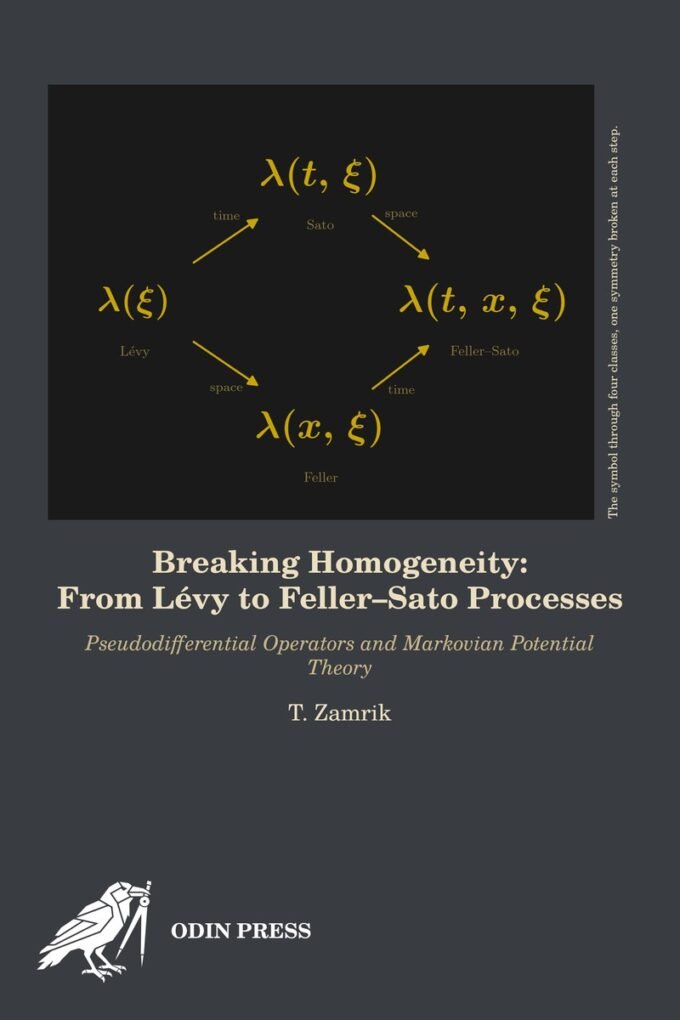
Breaking Homogeneity traces four stages of increasing generality. Each part breaks one more symmetry: temporal homogeneity falls first (Sato processes), then spatial homogeneity (Feller processes), until the fully inhomogeneous Feller–Sato class is reached. At every stage, the symbol remains a negative definite function in the Fourier variable — the single invariant tying the entire theory together.
The book covers infinite divisibility, Wiener–Hopf factorisation, Courège’s theorem, the parametrix construction, and heat kernel estimates. Potential theory is developed and compared systematically across all four classes.
Dr. T. Zamrik is an applied mathematician working at the intersection of stochastic analysis, probability theory, stochastic control, and partial differential equations.
The covers