Breaking Homogeneity: From Lévy to Feller–Sato Processes
Pseudodifferential Operators and Markovian Potential Theory
| Publication year | 2025 |
|---|---|
| Number of pages | 388 |
| Paper trim | 6 × 9 inch |
| Paper color | White |
| ISBN — Paperback | Forthcoming |
| ISBN — Hardcover | N/A |
| ISBN — Dust Jacket | N/A |
About this book
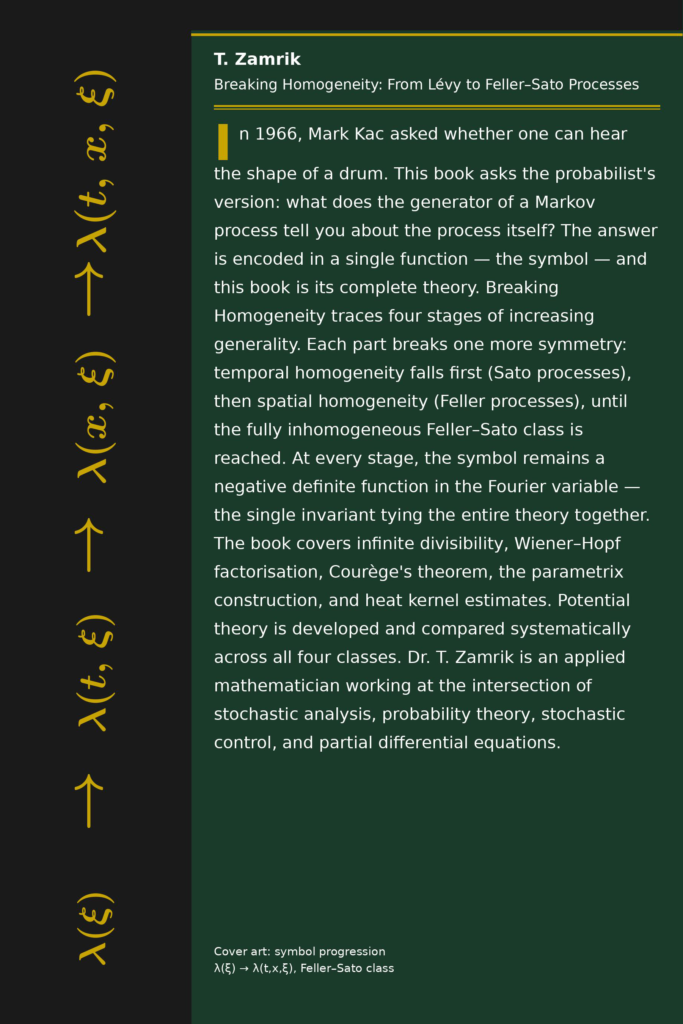
In 1966 Mark Kac asked whether one can hear the shape of a drum. Breaking Homogeneity asks the probabilist’s version: given a Markov process, what does its generator tell you about its trajectories? The generator is a pseudodifferential operator, and its symbol — the function λ(t, x, ξ) in the Fourier variable — encodes the infinitesimal structure of the process the way eigenvalues encode the shape of a drum. The symbol is the single object this book is about, and this is its complete theory.
The symbol takes four forms, and the book is organised by breaking one symmetry at a time. Constant in time and space, λ(ξ) is the characteristic exponent of a Lévy process, classified completely by the Lévy–Khintchine theorem. Introducing time dependence gives λ(t, ξ) and the additive, self-similar processes of Sato. Replacing time dependence with spatial dependence gives λ(x, ξ) — the Feller processes, characterised by Courège’s theorem as exactly those Markov processes whose generators obey the positive maximum principle. The full symbol λ(t, x, ξ) governs the Feller–Sato class, the most general family of jump-driven Markov processes with a rich potential theory.
Across fifteen chapters the book develops infinite divisibility and the Lévy–Khintchine representation, the generator as a pseudodifferential operator, Wiener–Hopf factorisation and ladder subordinators, Courège’s theorem, the parametrix construction, and heat-kernel estimates — and builds a Markovian potential theory of resolvents, excessive functions, and capacity systematically across all four classes, so the reader sees exactly what each broken symmetry costs and what it buys. It is written for mathematicians working at the intersection of stochastic analysis, probability, stochastic control, and partial differential equations.
Contents
- Infinite Divisibility and the Lu00e9vyu2013Khintchine Representation
- The Generator as a Pseudodifferential Operator
- Markovian Potential Theory: Resolvents, Excessive Functions, Capacity
- Ladder Processes and Wieneru2013Hopf Factorization
- Scale Functions for Spectrally Negative Lu00e9vy Processes
- Additive Processes, Self-Similarity, and the Time-Dependent Symbol
- Potential Theory for Sato Processes
- Feller Semigroups and the Positive Maximum Principle
- Couru00e8ge's Theorem: Characterizing Variable Symbols
- Construction of Feller Processes: Martingale Problem and Parametrix
- Potential Theory for Feller Processes
- Time-Inhomogeneous Feller Processes and Evolution Systems
- Pseudodifferential Calculus for u03bb(t, x, u03be)
- Heat Kernel Estimates
- Potential Theory at Full Generality
Covers