
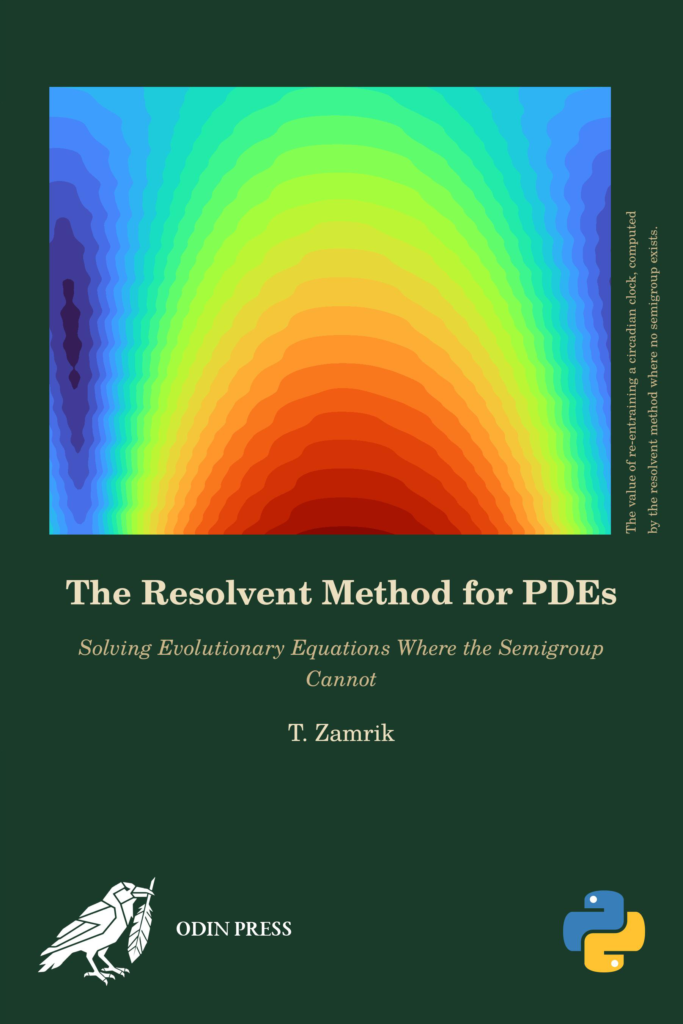
The Resolvent Method for PDEs
Solving Evolutionary Equations Where the Semigroup Cannot
| Publication year | 2026 |
|---|---|
| Number of pages | 358 |
| Paper trim | 6 × 9 inch |
| Paper color | White |
| ISBN — Paperback | Forthcoming |
| ISBN — Hardcover | N/A |
| ISBN — Dust Jacket | N/A |
About this book
The standard course in evolution equations puts the semigroup at the centre — the exponential of the generator, the operator that carries an initial state forward in time — and treats the resolvent, the inverse of the shifted generator at a single complex frequency, as the scaffolding one uses to build it. I hold the opposite view, and this book is the argument for it. The resolvent is the Laplace transform of the semigroup: prior to it, in the exact sense that the semigroup is recovered from the resolvent by an inverse transform — a contour quadrature carried to machine precision. Where both objects exist, this is a matter of emphasis. I insist on it because the two do not always both exist, and it is the resolvent, not the semigroup, that survives.
That the semigroup can fail is no pathology. There is a ladder of problems, each weakening one structural assumption, on which the semigroup degrades or ceases to exist while the resolvent still carries the solution. Drop self-adjointness and the eigenfunction expansion need not converge — I once watched a natural spectral series fail to represent a solution whose evolution the resolvent contour then recovered exactly. Drop autonomy and there is no exponential operator to name; the correct object is an evolution family, built from the frozen-time resolvents. Let memory enter and one has a resolvent family with no law of exponents behind it. Drop linearity and the resolvent becomes nonlinear, and the Crandall–Liggett formula generates a nonlinear semigroup from it with no smoothness assumed. The literature treats these cases well, each in its own monograph; what it does not do is carry the single thesis — the resolvent is the primary object — across all of them, to where two assumptions fail at once.
The thesis holds by exhaustion of the ladder, the object at every rung the same one wearing less structure. Part I establishes the Laplace–Bromwich duality and evaluates the analytic semigroup of a sectorial operator by contour quadrature, then builds the Dunford–Riesz functional calculus and the maximal-regularity estimate — both statements about the resolvent alone. Part II removes self-adjointness: where the eigenvalues mislead, the pseudospectrum is the honest diagnostic, and the resolvent contour recovers what the eigenvectors cannot. Part III removes density, autonomy, and the Markov property: the resolvent survives a non-dense domain, the Acquistapace–Terreni construction assembles the propagator from frozen resolvents, and the Mittag-Leffler resolvent family solves the fractional-in-time equation where no semigroup exists at all. Part IV removes linearity: the nonlinear resolvent generates the nonlinear semigroup and solves the Hamilton–Jacobi–Bellman equation as a tower of linear resolvents. The final chapter removes two assumptions at once — nonlinear and non-autonomous — and finds the value function of a real time-inhomogeneous control problem, the timed-light correction of circadian misalignment, as a convergent product of frozen-time nonlinear resolvents, computed on measured data rather than asserted.
Contents
- The Resolvent and the Semigroup: A Laplace Duality
- Sectorial Operators and Holomorphic Semigroups
- The Dunfordu2013Riesz Functional Calculus
- Resolvent Estimates and Maximal Regularity
- Non-Self-Adjoint Generators and the Failure of Eigenexpansion
- Pseudospectra: When Eigenvalues Mislead
- Degenerate and Non-Densely-Defined Generators
- Evolution Families and the Nonautonomous Cauchy Problem
- Constructing the Propagator from Frozen Resolvents
- Volterra and Fractional-in-Time Equations: Resolvent Families
- Accretive Operators and the Nonlinear Resolvent
- Viscosity Solutions and the Hamilton-Jacobi-Bellman Equation
- Policy Iteration as Iterated Linear Resolvents
- Time-Inhomogeneous HJB via the Nonautonomous Nonlinear Resolvent
Covers
Extra Material by the Author
- Companion code — GitHub → link